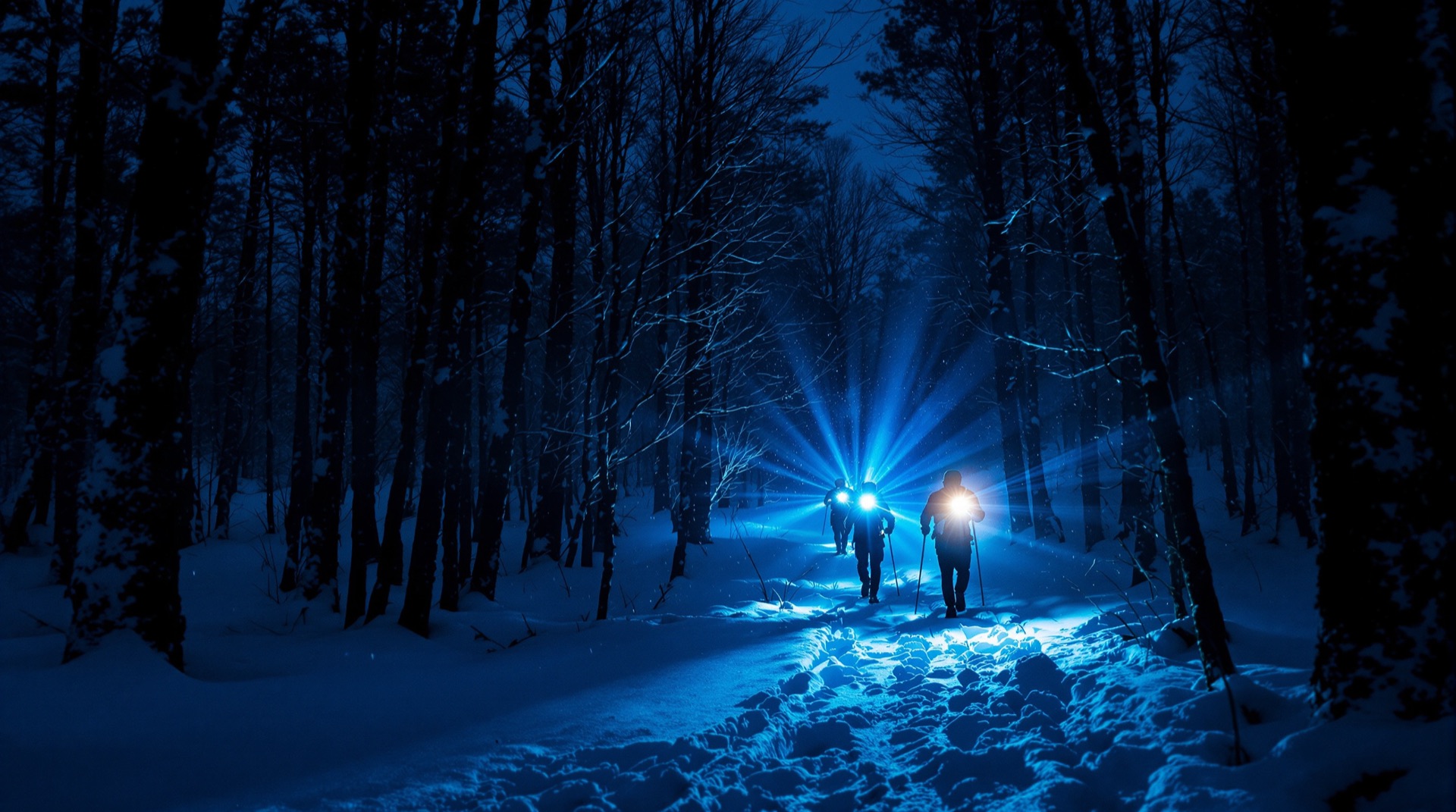
Every January since 2001, over the Martin Luther King Jr. holiday weekend, teams of racers have walked into the frozen state forests of southern Indiana carrying a map, a compass, a punch card, and enough food and resolve for 48 continuous hours. What began as a midwestern collegiate outing club's dare to itself has become one of the most respected amateur endurance events in the country. The event's story and hard-won wisdom follow.
What Is It?
The race is a 48-hour expedition-style orienteering event. Each team receives a topographic map marked with control points that must be visited in a specified order. The straight-line distance typically runs 20 to 40 miles — but terrain, navigation errors, and decoy controls mean teams should be prepared to cover 50 miles or more on foot. At every checkpoint, the team signs in with their arrival time and a comment (serious or otherwise), and a system of punches and punch cards verifies each find. There are decoys. Read the clue sheet carefully.
Why Winter?
Two reasons, both deliberate. First, the Monday holiday gives racers and volunteers a day to recover before facing work and school again. Second — and this is the soul of the event — a race in the dead of winter, when days are short, nights are fourteen hours long, and weather can swing from rain to ice storm without warning, tests will and endurance like nothing else on the amateur calendar. In a typical year only a small fraction of teams, sometimes barely ten percent, complete the full course.
Where Is It Run?
The first edition was held at Wyandotte Woods in southern Indiana, near where the Blue River empties into the Ohio. The location was chosen partly to prove a point: that Indiana has real terrain. Subsequent editions have rotated through the big southern Indiana public lands — steep, dissected hill country managed by the Indiana DNR Division of Forestry — and the point has been thoroughly proven. Ravines, creek crossings, multiflora rose, and 300-foot reentrants in the dark humble racers from mountain states every single year.
Who Can Race?
The original edition was an in-house event for club members. It worked so well that the field opened almost immediately: other campus clubs, other universities, and eventually the general public — or at least the fraction of it crazy enough to want this. Teams race in divisions (club, collegiate, open) of four to six members. Racing alone has never been permitted, and the team rule has a safety logic: a team that drops below four can continue informally, but the buddy-system redundancy is what lets organizers run a winter race at all.
What It Takes
- Navigation: Map-and-compass skill is the whole game. GPS won't save you; practice with resources from Orienteering USA long before race weekend.
- Feet: Fifty winter miles destroy unprepared feet. Racers learn sock systems, preemptive taping, and dry-feet discipline at creek crossings.
- Food: No aid stations — racers carry and manage their own nutrition for the full 48 hours. Calorie planning matters as much as fitness.
- Sleep strategy: The strongest teams decide in advance whether to push through both nights or bank a few hours in a fence-corner bivouac.
- Weather judgment: Check the National Weather Service forecast obsessively, then plan for it to be wrong. Hypothermia management is covered in our cold-weather safety guide.
The Days After
Finishing — or honorably scratching — a 48-hour winter race is only half the story; the recovery is the other half, and veterans plan for it as deliberately as the race itself. The first day is for warmth, real food, and sleep, in that order: a body that has burned through two nights of glycogen and slept in ninety-minute fragments needs refeeding and rest far more than it needs a victory lap. Macerated, blistered feet want air, dry socks, and honest attention before a hot spot turns into an infection. Expect two or three days of deep fatigue and a strange emotional flatness as the adrenaline clears — both normal, both temporary. The racers who come back year after year are the ones who respect the recovery as much as the suffering.
The Legacy
Alumni of the race travel across the country to come back and compete, and its format — long, cold, navigationally honest, fiercely volunteer-run — has influenced winter races throughout the Midwest. It stands as the best single argument for the outing-club ethos: a handful of students with maps and a state forest built something that has outlasted every one of its founders' college careers. If the race tempts you, start with our backpacking and snow sports guides and work up to a full winter night out.