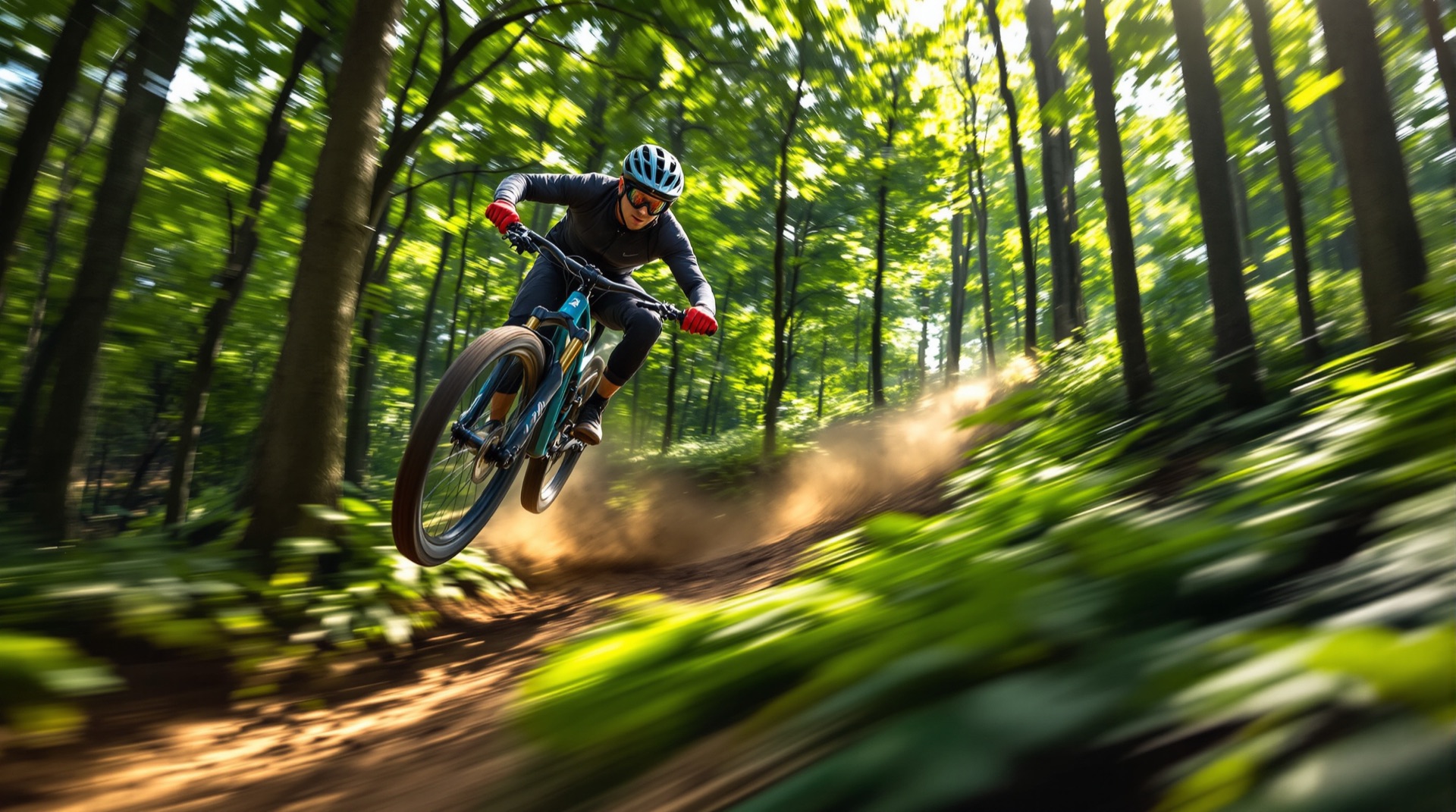
For decades, midwestern riders apologized for their geography. Then southern Indiana built some of the best flow trail in America, and the apologizing stopped. Mountain biking earned its place alongside climbing and caving in the outing-club rotation because it delivers the same formula: real skill, real consequence, real woods — an hour from campus.
Brown County: The Crown Jewel
The trail system at Brown County State Park is the reason Indiana appears on national riding maps. More than thirty miles of purpose-built singletrack roll through steep hardwood hills — machine-groomed flow, hand-cut technical lines, rock gardens on Schooner Trace, and the long backcountry feel of the outer loops. It has earned recognition from the international trail-advocacy community as a destination-grade system, and weekend trip reports from its bermed descents filled club archives long before the secret got out. Ride it in October and you will understand the entire region in one afternoon.
The Rest of the Map
- Versailles State Park: 25+ miles of stacked loops in the southeast — the other half of Indiana's state-park riding crown.
- Town Run Trail Park, Indianapolis: the city fast-lap venue along the White River.
- France Park, Logansport: limestone quarry scenery and punchy tech.
- Griffin Bike Park, Terre Haute: a volunteer-built park with progression lines from green to gnar.
- Louisville and beyond: a short hop south adds the big systems of the Ohio River valley for full-weekend rides.
Skills, in Order
The club method applies on wheels: progress deliberately. Body position first — level pedals, heavy feet, light hands, eyes far down the trail. Then braking control (one finger, before the corner, never in it), then climbing traction, then cornering berms, and only afterward the airborne ambitions. Most early crashes are braking errors wearing a disguise. Helmets are non-negotiable, gloves nearly so; the rest of the armor scales with the trail. Our safety primer covers the first-aid kit that should live in every pack, and the gear closet covers the tools — because the rider who can't fix a chain ten miles into the backcountry is a pedestrian with expensive luggage.
Trail Citizenship
Every mile of midwestern singletrack exists because volunteers dug it. The International Mountain Bicycling Association and its local chapters wrote the modern playbook — sustainable grades, rolling contour, ride-arounds — and local crews maintain it with shovels and Saturdays. The etiquette is simple: yield to hikers and horses, announce yourself, never ride wet clay trails (ruts last for years), and put in a trail-day before you put in a complaint. Group rides follow the same discipline as any club outing — designated sweep, regroup points, nobody dropped — and our group trip planning guide translates directly from boots to knobbies.
The Trailside Repair Kit
Self-sufficiency is the rider's version of the climber's partner check. The minimum kit that lives in every pack or saddle bag: spare tube (even if you're tubeless), pump or CO2, tire levers, multi-tool with chain breaker, quick link, and a few zip ties — the duct tape of the bicycle world. The skills to practice at home before they're needed ten miles out: fixing a flat, rejoining a snapped chain, straightening a bent derailleur hanger enough to limp home, and adjusting brakes that have gone soft. The traditional club ride rule was that the group carries collective redundancy — two pumps, two sets of levers — and that nobody's mechanical strands them alone. A rider who can't fix a chain is a pedestrian; a group that won't wait for repairs is just strangers on the same trail.